





Prediction markets are growing fast, and platforms like Kalshi and Polymarket are at the center of the conversation. What used to feel like a niche corner of the internet now looks more like a serious financial product, with one report from TRMLabs showing monthly transaction volume jumping from about $1.2 billion in early 2025 to more than $20 billion in January 2026 and YahooFinance saying prediction market transactions topped 192 million in March 2026. This growth has made it harder to ignore the questions around regulation, ethics and whether these markets are really forecasting tools or just another form of betting.
At the simplest level, prediction markets let users buy and sell contracts tied to real world outcomes like elections, sports games or economic data. If people think an event is more likely to happen, the price goes up. If confidence drops, the price falls. Platform supporters say this makes the market useful because it can pull together public information better than a poll or a pundit prediction which is usually from an authoritative figure in government or politics, but critics worry that it also gives an edge to anyone who has access to private information.
It sounds simple enough, but the bigger these platforms get, the more complicated they become. A student can open an app and make a quick guess on an election result or a sports matchup, but behind the easy interface is a market structure that touches finance law, consumer protection and questions about who gets to profit from information first. Kalshi and Polymarket are drawing more attention now than they did just a few years ago.
Kalshi and Polymarket are the biggest names in the prediction market space. Kalshi is regulated by the Commodity Futures Trading Commission, while Polymarket has built its business through crypto-based trading and a more complicated legal path in the United States. In March, both companies said they were cracking down on insider trading, including new limitations for politicians, athletes and others who might have information the public does not, which happened after federal regulators warned that “event contract” markets can be vulnerable to fraud and manipulation.
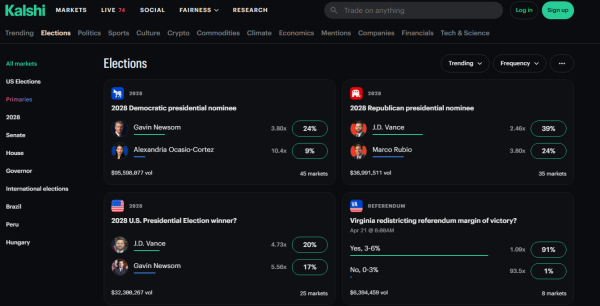
The Associated Press reported that the federal government has pushed back against state attempts to regulate prediction markets, while Congress has started taking a harder look at contracts involving sports, elections and other sensitive topics. In another story, oddly timed Polymarket bets tied to the Iran war raised new concerns about whether some traders were acting on information the public had not seen yet.
The issue is as the heart of what prediction markets are supposed to be. On one hand, they are praised for turning scattered information into a useful number that can help people understand what might happen next. On the other hand, they can become tools for speculation if people are betting based on information that should not yet be public. Ethical lined starts to blur when market that is supposed to measure public expectations loses some of its value if a few users can move ahead with knowledge the rest of the crowd does not have.
For a University of North Georiga finance major, the big issue is not whether these markets are interesting, it is whether people can trust them. Companies are being marketed as serious tools for reading the future, not just novelty bets.
“Prediction markets can be useful for forecasting, but if traders have access to private information, the market stops being a clean measure of public expectation.” – James Welsh, Senior, Finance
There is still a basic question underneath all of this: what are prediction markets actually supposed to be? Economists have long argued that markets can gather information better than any single expert can, especially when people have money on the line. But if the system is easy to game, then the price may tell users more about who had insider knowledge than what is likely to happen next.
Kalshi and Polymarket sit somewhere between Wall Street and sports betting, between data and speculation. For students watching how fast the industry is expanding the question is not just whether these markets are useful, it is whether they can grow without turning into another place where the most informed insiders have the biggest advantage.
Students who use apps for investing, crypto or sports betting are already familiar with digital platforms that turn uncertainty into a price. Kalshi and Polymarket package investing into a more formal market, which makes them feel modern and accessible, but it also makes the consequences easier to miss. A contract that sounds harmless at first can become a serious ethical problem if it is tied to elections, war or other public events with serious stakes.
The debate is likely to keep growing because the platforms themselves are not slowing down. As more users join, more money flows through the system and more people outside the industry start asking how these contracts should be treated. If regulators decide the platforms are closer to financial exchanges, the rules may tighten. If lawmakers decide they resemble gambling products, the companies could face a very different future. Either way, the next few months may decide whether prediction markets become a normal part of finance or a cautionary example of innovation moving faster than oversight.