



The University of North Georgia MakerBot Innovation Center is an open-access 3D printing lab in the Choice Street Arts Complex. It is the first MakerBot center established in Georgia and allows faculty, staff and students to learn and develop skills used in many fields, from engineering to art, biology, physics and business.
It is overseen by Jon Mehlferber, head of the Department of Visual Arts, who helped with the initial funding of the research project in 2013.
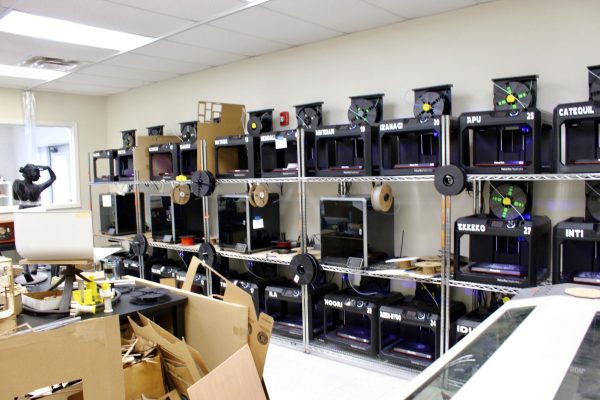
At the time of establishment, the center had 32 3D printers. Since its launch, an additional seven printers have been added. The MakerBot 3D printers were the best available technology for the center. Mehlferber said they were time consuming to assemble. “It’s not that I wanted to build my own printer,” Mehlferber said, “but it was the only option back then because they were used in industry… It was intriguing to have something that was desktop size and something that, you know, was affordable. I think it was like $2,000. So we got a couple of those and built them.”
In 2017, Mehlferber worked with the UNG Department of Physical Therapy using MakerBot 3D printing to create assistive devices for children with disabilities.
Mehlferber said, “Let’s say that normally (an assistive device) would take six weeks and cost $8,000. We could do that same thing in 24 hours at a cost of $20.”
This interdepartmental project was one of the first successes of the MakerBot 3D printers. UNG granted the MakerBot Innovation Center additional funding to officially be established as a lab on the UNG Dahlonega campus in 2017. Mehlferber said, “You know, we’re artists, so you can make beautiful objects. That’s one option. But I also was intrigued by the idea of the usefulness in terms of making things that could help people.”
Developing and maintaining 3D printers on the scale of the UNG MakerBot Innovation Center has made acquiring funding a specific challenge for Mehlferber. “I made a couple proposals for funding that basically were open-ended.” Mehlferber said. “People want to know, what are you going to do with the money? What are the students going to make? The point is I have no idea what they’re going to do. You know, if they want to be entrepreneurial, they want to start their own company making whatever. They could do that using this facility.”
“It’s always a surprise what they come up with,” said Mehlferber, “And that’s the value of being able to explore something that’s new like this is that you, you don’t know what it’s capable of until you start, you know, doing it.”
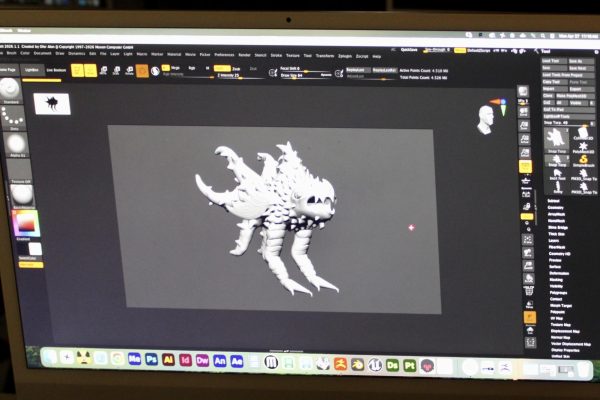
Classes taught through the art department in Digital 3D Modeling and Printing help students learn how to design 3D models. Students are able to collaborate and have hands-on experience in digital manufacturing and prototyping. The Innovation Center teaches students every aspect of the 3D printing process, from concept to execution to refinement of the finished product.
Mehlferber said, “Students that know how to use these tools can go out and get jobs that otherwise they wouldn’t be able to.”
The center is overseen by the Department of Visual Arts, but students have found practical applications for 3D printing across a wide variety of majors.
Avery Kelly, a senior studio art major, said, “Before I was an art major, I was an engineering student… I didn’t want to do it anymore. So then I pivoted and it took me three years to be like, oh, wait, there’s art classes that have to do with 3D software. So then I just went into that because that’s what I wanted to do originally.”
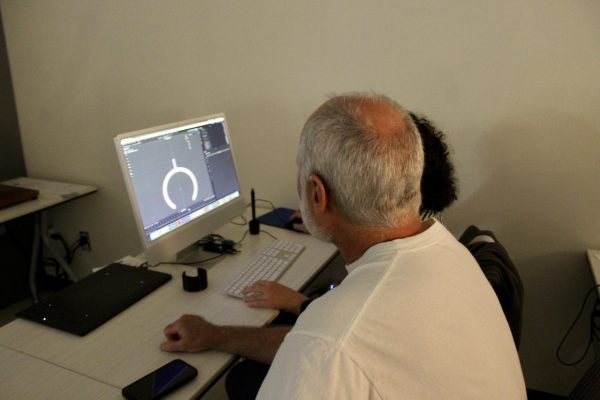
Valentina Osorio, a junior communications major, said, “The thing that stood out is how much assistance that I can get. Like in the moment when I’m designing something and then I run into a problem, I can get assistance right then about what to do to fix it so I can make sure that it works… Mehlferber is really helpful with things like hands-on stuff.”
Along with creatively supporting students, Mehlferber emphasizes the value of being technologically self-sufficient. “There’s a lot of planned obsolescence with things that are sold to us these days. If you break one thing apart, you’ve got to throw the whole thing away and buy a new one. That’s very wasteful,” he said.
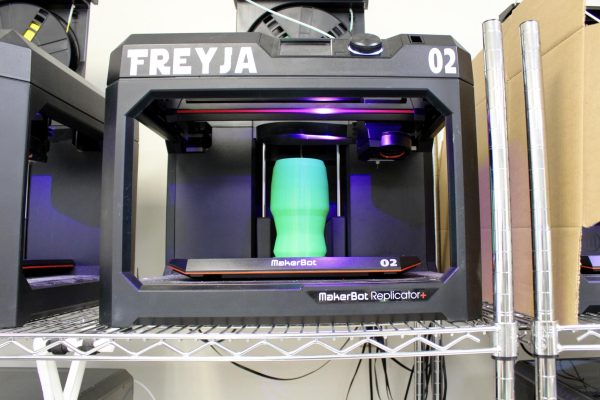
Mehlferber says professors across UNG have found the MakerBot Innovation Center to be highly useful in creating visual representations and new educational tools that can further help students learn.
Mehlferber explains, “We have had professors over the years- from biology, from chemistry, from math, from physics- all different areas come and do projects because they could and design that into their courses as a project that their students would work on.”
The UNG Innovation Center has also worked with local businesses to create parts and pieces that would have otherwise been cost-prohibitive. “We had someone that was visiting Dahlonega, and they just saw the place and they walked in,” states Mehlferber. “They actually themselves made use of 3D printing to create their product that they sell. And so they were interested to know that we were kind of doing a similar thing, teaching people how to use those things.”
The center has created parts for labs and businesses across the country, including the biology lab at the University of California, Berkeley and Kubota, printing new wheel designs for their tractors.
Mehlferber says students are encouraged to come to the lab, “You should come check it out and see what you can do with it.”