


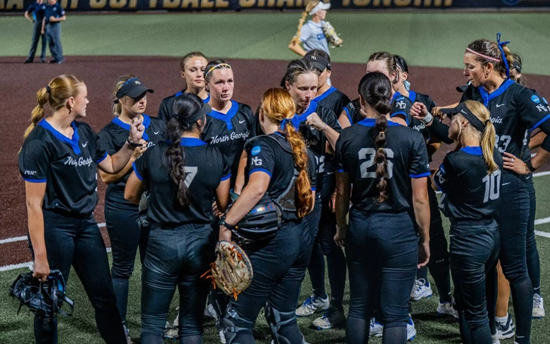



As the semester comes to a close, seniors are bracing themselves for the inevitable “What comes next?” Whether living on campus or commuting, being on a college campus builds a routine and process. Students know where everything is, and their days are planned around their class schedule.
Lori Cleyman, career specialist at UNG, says that there are a lot of challenges that come with the transition. Once college students graduate, they will need to be prepared for what comes next and the dichotomy between college and the workforce. “It’s a big transition, and for some people, it’s smoother than for others. And it kind of depends on a lot of variables and how much effort and work you were able to do while you were here in order to prepare yourself for that next transition,” she says.
Cleyman recommends students to use UNG resources like Career Services and Financial Well-being, which provide consultations and host workshops and graduation boot camps to prepare for some of these scenarios. Resources, including the Graduation Boot Camp and workshops hosted by Career Services and transcripts and recordings of past workshops and discussions, can be found here.
The Job Search
For many students, job searching is the first major hurdle after graduation. Cleyman stresses that preparation should start well before senior year. One of the first steps, she says, is understanding what experience employers are looking for: soft or hard skills that are popular in job listings. She says to look into whether you can develop those skills “by being in a club or organization on campus, or a part-time job on or off campus. Are there extra classes that you can take that will give you a certain kind of knowledge base that maybe you’re lacking?”
Even if seniors did not prepare like this, they don’t need to check every box. “You do not have to meet 100% of the qualifications… if you meet about 60 to 70%, go for it,” she says.
Soon to graduate, Campbell Fretz, a biology major with a concentration in coastal ecology at the College of Coastal Georgia, who transferred from UNG to CCGA for a marine-focused major, found that early hands-on experience was transformative. After interning with the Georgia Department of Natural Resources, she now works part-time as a coastal wetland technician and is applying for full-time work. “I’m applying to a bunch of different job positions that are both in and maybe slightly outside of my current experience level… even if you don’t think you can get it, just put yourself out there,” she says.
Both Fretz and Cleyman stress the usefulness of internships, not only as resumé builders, but as career navigation tools. “I think that having an internship is something that everyone should try and do at least once,” Fretz says. “[My internship] helped me figure out kind of my career path that I wanted to take.”
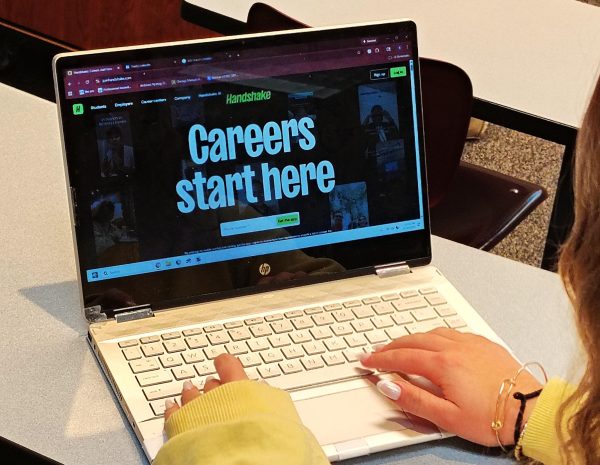
When searching beyond local opportunities, Cleyman says graduates should diversify their job-hunting methods. She recommends using Handshake, LinkedIn, local staffing agencies and the Chamber of Commerce in the area where you want to live. Some businesses, especially smaller ones, may not advertise on major job sites. Fretz recommends searching through job vacancy announcements, as well, since organizations like Georgia DNR usually do not post job applications on sites like LinkedIn.
Applying to jobs can also take time, Fretz says, “Start looking at jobs three months before you graduate, then start applying around two months to one-and-a-half months before you graduate. Because here’s the thing, those applications take a while to process… and you will have to keep shooting them out until you hear back because nine times, you’re not going to hear back from anyone.” She also emphasizes that people should only apply to each position once, then if it closes and reopens, send another application.
Making Friends
Graduating doesn’t just disrupt academic routines, it shakes up social ones, too. In college, friendships often form organically through classes, clubs and campus life. After graduation, students may worry about maintaining or building a social circle.
Cleyman says this concern is extremely common among new graduates. Social connections outside work are important not only for mental health but for building a sense of home in a new area. “A lot of students are very concerned about how do you make friends once you leave school,” she says.
Fretz notes that while she has made meaningful friendships in classes and at work, most connections stay within those settings. Overall, social circles can be a big motivator. “I have a best friend that I hang out with a lot, and we can’t meet in person due to the distance, but we call relatively often… She’s been pushing me to pursue my hobbies and my interests and my loves since we met.”
Cleyman says she also does not hang out with her coworkers and wants “to see other people outside of work.” She suggests inviting people to events, joining clubs or organizations or hanging out at a popular place like a coffee shop.
“If you like running, they have running clubs all over the place. If you like cycling, they have cycling clubs all over the place. If you enjoy ballroom dancing, I guarantee there’s someone somewhere that does ballroom dancing. I say those just because there are so many opportunities: it does just take some searching,” Cleyman says. “You have to be proactive. You have to go out and join them. They are not going to come to you. They are not going to find you.”
Fretz echoes the sentiment that finding “your people” takes time. “Everyone’s got their own speed at finding these things,” she says.
Relocating
For some students, graduation may mean moving to a new place.
Fretz says her small town on the Georgia coast doesn’t have a lot of jobs in her profession. “This is where I’m struggling because there’s a lot of competition given the amount of jobs versus the amount of people looking for the jobs,” she says, “I think that if I was, say, like in Florida, I’d have a lot more jobs that I could apply for.”
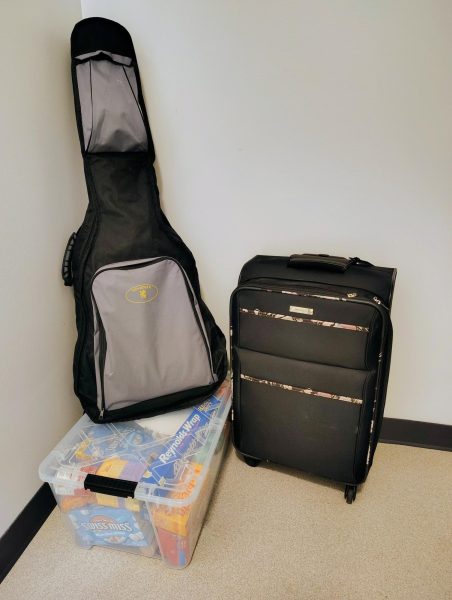
Cleyman recommends researching the area thoroughly before moving. One unexpected resource: the local newspaper. When she moved to Dahlonega, she subscribed immediately to understand the community. “It helps you also just understand the culture of the area, what’s important, what kind of activities are going on… and what are the local concerns,” she says.
Cleyman recommends students weigh the cost of staying in the new location against the benefits of moving somewhere else or not moving: job prospects, pay ranges, opportunities for professional growth and commuting distances.
Commuting, especially long-distance commuting, can heavily impact work-life balance, Cleyman says, “If you’re commuting an hour and a half, twice a day, that’s three hours on the road… And also just simply if you’re working 40 hours a week and, you know, I don’t know, drive 15 hours a week, that really takes a toll.”
Budgeting
Cleyman says that financial stress often intersects with career decisions. Students sometimes insist they need to earn a specific amount, only to learn their spending habits, not their income, are the primary issue.
She often refers students to Financial Well-Being, located in the Stewart Center on the Dahlonega campus, to examine where their money is going. In many cases, students discover they can cut expenses and adjust expectations. “We definitely want to make sure you keep a roof over your head and food on the table,” she says. But students also must be realistic about what jobs in their skill range and area can offer.
Graduates should prepare a budget that accounts for:
- Rent and utilities
- Groceries and essentials
- Car payments
- Insurance
- Gas
- Student loan payments
- Emergency savings
- Recreational expenses
Fretz says that if you plan out major expenses, financial issues could come from the gradual build-up of small, routine costs. Many people don’t realize how much money disappears through everyday habits, such as buying coffee, eating out or convenience purchases. She suggests looking into “meal prepping and seeing how much meals will cost, because you can make literally like Google ‘$10 meals’ or ‘$5 meals’ and it can make four to five things.”
Part of budgeting also includes preparing for the future. “I think just trying to set aside like $20 a month is a great thing because it builds up after a while. I think it’s important just to save a little bit each month if you can or every paycheck, even if it’s $5 per paycheck, it’s something,” Fretz says.
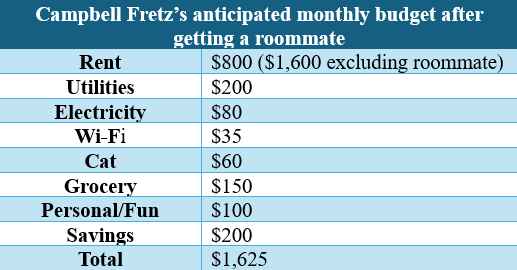
Campbell emphasizes that budgeting isn’t just about cutting back, it’s about building awareness. Creating a budget to track spending helps people identify patterns and understand where their money actually goes. For new graduates, that awareness can make the difference between financial stability and unexpected stress.