




Anonymous apps, which separate expression from personal profiles, have gained traction on college campuses in both the United States and Taiwan.
According to a national survey from the Pew Research Center, a nonpartisan, non-advocacy fact tank that studies public attitudes and social trends, 74% of teens say social media platforms make them feel more connected to their friends.
The research also found 38% say social media makes them feel worse about themselves, and 29% report feeling pressured to present themselves in a certain way online.
These findings highlight both the emotional impact social media has on Gen Z and the concerns many young users feel about presenting their identities online, factors that have contributed to the rising interest in anonymous spaces.
Two major platforms, YikYak in the United States and Dcard in Taiwan, show how Gen Z approaches anonymity differently depending on culture, campus life and platform design.
YikYak: Hyperlocal anonymity on American campuses
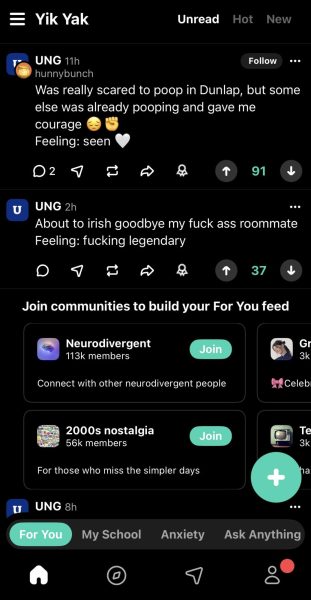
YikYak describes itself as “an anonymous community app for college students that helps you feel at home on campus… with real personality and zero name tags.” After shutting down in 2017, the company relaunched in 2021 with strengthened safety tools.
In a written interview, the YikYak team said the platform now includes stricter enforcement. “We’ve added permanent bans, which prevent repeat-offenders from using the platform. We’ve also expanded the moderation team, added AI tooling, and have an average flag-to-action time of under a minute,” the team wrote. They said trust was rebuilt by “listening to our users,” making it easier for them to report content and “provide moderation with a little note for added context.”
The team said the app “embrace[s] anonymity by allowing users to express themselves but enforce[s] our guidelines strictly.” The moderation system combines automated filters, downvote-based removal and rapid human review. “User reports and AI detected content is reviewed by our moderation team in less than one minute,” the customer support employee wrote. They describe the typical feed as campus focused, jokes, questions, recommendations, Greek life, events and the struggles of college life.
For Katelyn Vieira, an American sophomore majoring in mathematics with a minor in statistics at the University of North Georgia, the hyperlocal nature of YikYak is part of its appeal.
Vieira said she first learned about the app from her freshman-year roommate. Since then, she said she reads “super random posts, anything ranging from food to school questions to hyping someone up or complaining.”
Anonymity shapes how willing she is to share. “I definitely feel more comfortable expressing thoughts and emotions on YikYak because it’s anonymous,” she said. “It makes it so easy to post because even though people are incredibly rude sometimes, you can embarrass yourself without anyone knowing it’s you.”
Vieira said she has “absolutely” shared personal or emotional posts. While “some people were judgmental,” she said, “the majority often gave me advice or some words of encouragement.” She added that anonymity also has drawbacks. “People can be very mean on there,” she said. “Other people just hide behind their screen and bully random posts because they have nothing better to do.”
She describes the overall atmosphere as “a casual group chat setting,” filled with posts about “period cramps, worries for finals, how hungry they are.” For her, YikYak is a connector. “It either connects me to people through posts or connects me to answers through the questions I ask,” she said. “It is basically just an anonymous group chat for me.”
Dcard: Structured anonymity and campus culture in Taiwan
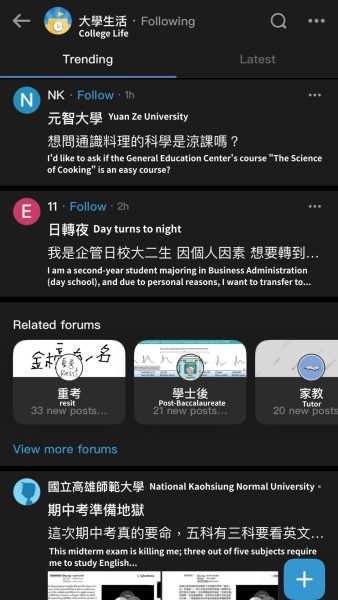
Taiwan’s Dcard began as a university-only anonymous platform. In a written response, a Dcard customer service team member said the platform first attracted students because it was “anonymous and campus limited.” As the user base grew, posting shifted “from pure anonymity to offering options such as school departments and ‘card names,’” which function like custom usernames. Registration also expanded from college email-only to ID and phone verification.
To maintain campus belonging, the company said it launches “seasonal activities tied to the academic calendar,” provides school-specific boards so students have “a dedicated space to discuss campus affairs” and “regularly hosts in-person events across universities.”
For Li Chun Yi, a Taiwanese senior majoring in social work at Tzu Chi University, anonymity is the reason they continue using Dcard. Li said anonymity allows them to “clearly say what I think without being afraid that people will find out it was me.” It also allows them to ask “more private questions or emotional questions and even things that are politically incorrect,” without concern that classmates will view them as “strange.”
Li said they feel more comfortable expressing themselves on Dcard than in person. “Because no one I know will discover it’s me, and strangers also won’t know it’s me,” they said. “In front of other people, you might still have an image to maintain. Anonymity is the most real version of myself.”
Although Li does not typically post personal experiences, they sometimes react strongly to content. They recalled moments of emotional expression, such as commenting, “How can anyone think like this? People who think like this should go to hell.”
Li described the platform as “fairly rational,” saying that, even in controversial threads, “there is always someone who comes out and says we should comment properly.” At the same time, they said Dcard has “become a place where gossip is scattered,” especially about schools or academic departments.
In their view, Dcard serves as both a “whistleblower” platform, where students reveal gossip or campus incidents, and an “information sharing” space for beauty tips, travel recommendations and events. Anonymous interaction, they said, offers comfort. “I’d say it’s psychological healing, for getting support. Sometimes that’s when you are your most real self.”
Why anonymity resonates: A psychological explanation
Carson A. Teems, an American senior psychology major at the University of North Georgia who will graduate in December, studies online anonymity and mental health as part of his undergraduate research. Teems said students’ motivations for using anonymous platforms reflect deeper emotional needs. He said, “Young people… feel more comfortable expressing themselves anonymously online due to the low-risk environment” anonymity provides. It offers “a psychological distance” that reduces fear of judgment and allows students to ask vulnerable questions “without fear of being stigmatized or suffering reputational damage.”
Teems said anonymity encourages “honesty and authenticity,” since it removes concerns about social image. It also offers “validation and support,” because “receiving empathetic responses, even from anonymous strangers, can feel validating.” Students seek “belonging and community,” especially when they feel unsupported offline, and anonymity provides “control and emotional safety,” letting them regulate how much they disclose.
He added that Gen Z’s emotional landscape is shaped by broader pressures. Young people experience “high levels of stress, uncertainty and overwhelming emotions,” and they are “searching for places to process emotions.” Many also seek “connection without the pressure of reputation,” especially when they “feel judged or misunderstood in offline environments.”
Teems noted that social media itself contributes to both support and stress. He cited American Psychological Association research from 2018 showing that 55% of Gen Z report that social media provides them with feelings of support when they are stressed, while 45% report feeling judged, and 38% report that using social media makes them feel bad about themselves.
A generation searching for safer spaces
Across countries, the appeal of anonymous platforms reflects a shared desire among Gen Z students to communicate without the weight of reputation. On American campuses, that shows up in what Vieira calls “a casual group chat setting.” On Taiwanese campuses, it appears in what Li describes as a mix of gossip, information sharing and “psychological healing.”